


Technology
Shaping the Future of Efficient Computing
What is the Challenge?
The growing need for speed and efficiency is one of the biggest challenges in information technology. To meet these demands, most of the devices and cloud computing services today offer the possibility to run software on more than one core or on specialized processors, such as Graphic Processor Units (GPUs) or Field Programmable Gate Arrays (FPGAs). Optimizing performance thus becomes the decisive question of exploiting the opportunities of parallelly executing code.There are two underlying principles:
- The better a code can be distributed among different processing units (arithmetic logic units [ALU], CPU cores), the faster the computation can be done.
- The more precisely code is adapted to specific hardware, the more efficient it will run on the respective device.
An application can only yield optimal results, if code and hardware are a perfect match. However, the process of designing, implementing and deploying software is becoming more complex in modern computing environments. Apart from hardware design and inherent code properties, the efficiency of the programming process also depends on the individual programmer’s personal skill level and experience.
LAYCOS: Making Software Hardware-Intelligent
LAYCOS addresses exactly this challenge by making software hardware-intelligent. LAYCOS stands for «Latency-Optimized Code Segmentation» – a patented method that enables software to automatically understand the hardware in a novel way, which allows an optimal use of its capacities.
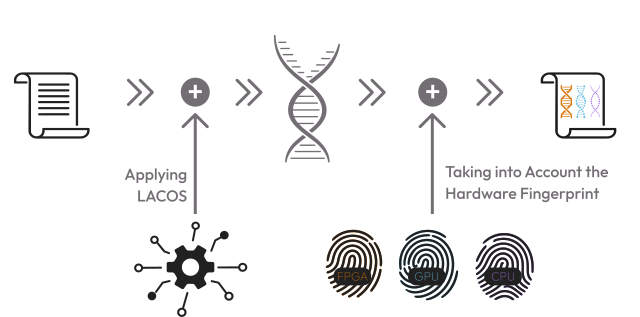
Our method unfolds its value at the intersection of software and hardware: It breaks down software code into the smallest “fastest computable” units before distributing them across the targeted hardware. During this process, LAYCOS adapts the code to the hardware’s specific requirements (= hardware fingerprint). Taking into account physical dependencies at hardware and data levels, it enables code to run in an optimal way, maximizing its performance across all platforms, from microchip to supercomputer. Additionally, LAYCOS can be used to create a code-specific hardware design.
In doing so, the method automates a process that is still manual, complex, and time-consuming today. As an expert system, it supports programmers in achieving the best possible results, leading to optimized software performance, energy savings and shorter time to market at the same time. This way, code performance no longer depends on chance. With LAYCOS, it becomes a strategic advantage.

How it Works - From Code-Level Optimization to Physical Intelligence
Mynatix’ technology is based on a naïve yet radical approach: Software itself should understand how to run best on the given hardware. To achieve this, LAYCOS addresses a long-standing issue: detecting parallelism in code – and adapting it to automatically exploit the hardware’s (parallel) capabilities in a generic way.
Think of it as a manager who is instructing a team: If large projects are split up into smaller tasks and distributed among several people, the job can be completed faster. To achieve this, two things need to happen:
- The manager needs to communicate all relevant task-related information to the workers.
- The workers must then use this information to execute their respective tasks.
Until now the manager’s job in computing has had to be done manually by programmers during software development. A compiler is a computer program that translates human-readable source code into machine code that can be executed by a computing unit. Traditionally, compilers have had a restricted view on parallelism in code, and therefore limited capabilities to orchestrate workers and communication. During compilation, the compiler analyzes the code, divides it into basic blocks, maps them to available machine instructions, and optimizes execution for a specific computing unit.
Each block contains instructions on how to order it into a sequence of other software blocks to achieve the best results. These instructions are usually provided sequentially. Depending on the hardware architecture, it may be necessary to reorder the given instructions or to distribute them to different cores to optimally use the hardware’s computational power. Exploiting this information is called instruction-level parallelism (ILP) and provides the logical foundation for correctly handling control and data dependencies, guaranteeing that a program can be correctly written by the programmer and successfully executed.
Modern compiler frameworks efficiently optimize code for a target architecture with a single computing core. However, most of the modern computational challenges increasingly rely on platforms with multiple cores or special units that support parallel execution (e.g. GPUs). This is a matter of efficiency: if a problem can be broken down and solved by several computing units simultaneously, it can often be solved faster and more efficiently. This approach is known as parallel programming.
In systems with multiple computing units, programmers using state-of-the-art compilation technology are left to adapt their code manually to the specific architecture. This requires time, effort, and a certain degree of expertise. It starts with designing an algorithm and writing an appropriate code in a suitable language, while considering the hardware’s physical computing capabilities.
Although there are tools and libraries to support developers with this, fully automating the parallelization process remains challenging. The fact that parallelism often depends on runtime variables – whose meaning is only known when the code is running – further increases complexity.
Using Novel Code Segmentation to Automate Software Optimization
LAYCOS offers a novel way of code segmentation improving the automatic optimization of code to hardware. To fully exploit the potential of parallelization, Mynatix optimized an aspect of the programming process whose potential has long been considered exhausted: data dependency analysis.
Since the 1970s, compilers have been following this principle to exploit ILP: By identifying data dependencies, compilers and hardware ensure that instructions within the code are kept in the correct order during translation. This is intended to prevent data hazards, which occur when an instruction requires data that has not yet been produced, causing delays or incorrect results in the programming process.
There are three types of data dependency that can lead to hazards:
- read-after-write (RAW)
- write-after-read (WAR)
- write-after-write (WAW)
There is a fourth dependency:
- read-after-read (RAR)
However, it cannot cause any data hazard and has therefore not been considered so far. Yet: RAR contains relevant information about the ILP. LAYCOS is the very first technology to consider this additional bit of information contained within any code.
Based on the physical laws underlying the process of code segmentation, it leverages the additional RAR dependency to:
- retrieve parallel opportunities in a code by generating parallel code segments with flow dependencies (RAW) from statements / instructions
- store these segments in a generic form by keeping the unique order of these parallel computable segments
Thus, LAYCOS takes over a task usually be done by experienced programmers and opens new possibilities for automatically optimizing the distribution of computation based on static code analysis.
It can be applied to any code. With its hardware-agnostic approach, this fundamentally novel method works in any environment, from microcontrollers and servers to the cloud. It can also be used to improve hardware, e.g in the context of high-level synthesis, ASIC pipelines or exploiting the ILP on compiler side.
This leads to several advantages:
- No manual code adaption needed – code adaption to hardware is done automatically
- Increased efficiency and performance on any platform (e.g. for simulations, AI, and data processing)
- Reduced energy consumption by hardware-aware code execution
- Easy integration in existing workflows, both on programmer and company levels
- Scalability makes the solution suitable for individual programmers, software providers, and software tool providers
With this disruptive approach to enhancing automatic code optimization, Mynatix redefines compiling technology in the 21st century – shifting the focus from syntax and code-level optimization to physical intelligence.
Read more about the core application areas of LAYCOS.

Technical Insights
The LAYCOS technology is a scientific process following specific criteria. Initial proofs of concept (PoC) have demonstrated how LAYCOS unlocks previously untapped performance potential on multicore processors, GPUs and FPGAs.
Proofs of Concept and Scientific Publications
A successful pre-study was conducted with Innosuisse, the Swiss Federal Agency for Innovation, in 2022. After securing the intellectual properties by five international patents, Mynatix now prepares an Innosuisse project to strengthen our scientific proof of the advantages of the LAYCOS technology.
In different fields, PoCs demonstrate the benefits of applying LAYCOS to parallelize code on multicore CPUs, transpiling code to GPUs and creating optimized FPGA-designs without any programmer interaction. A series of first results have been presented at an international conference and published as a peer-reviewed article.
You can find an overview of research papers and studies providing more technical insights into our approach on here.

Patent Family
LAYCOS is being protected by a PCT patent family. This high level of protection makes it the basis for multiple technological applications.
Here is an overview of the filed and granted patents:
Patent family
| Area | Patent | PCT filed | Patentability | Published | Country filing | Granted |
|---|---|---|---|---|---|---|
|
Compiler / Transpiler technology (LAYCOS)
|
P1317 System for Auto-Parallelization of Processing Code | PCT filed: completedPCT filed | Positive patentability report: completedPatentability | Published: completedPublished | Country filing: completedCountry filing | Granted: completedGranted |
|
LAYCOS application for Operating System Kernels
|
P1423 Hardware-optimized, High-Performance Auto-Parallelization System | PCT filed: completedPCT filed | Positive patentability report: completedPatentability | Published: completedPublished | Country filing: completedCountry filing | Granted: pendingGranted |
|
LAYCOS application for high-level synthesis (HLS)
|
P1422 System for Design and Manufacturing of Multi-Processor and Multi-Core IC | PCT filed: completedPCT filed | Positive patentability report: completedPatentability | Published: completedPublished | Country filing: completedCountry filing | Granted: pendingGranted |
|
LAYCOS application for Chip Design
|
P1473 System for Generic Static Multiple Issue Integrated Circuit Design | PCT filed: completedPCT filed | Positive patentability report: completedPatentability | Published: completedPublished | Country filing: completedCountry filing | Granted: pendingGranted |
|
LAYCOS application for Quantum Computing
|
P1482 Quantum Computing System With Auto-Parallelized Quantum Processing Units | PCT filed in February 2025: completedPCT filedFeb 2025 | Positive patentability report: pendingPatentability | Published: pendingPublished | Country filing: pendingCountry filing | Granted: pendingGranted |
The positive PCT-patentability reports show the novelty and applicability of the method in a key step challenging most codes:
translating from a programming language to a machine code.